Last updated: November 21, 2026
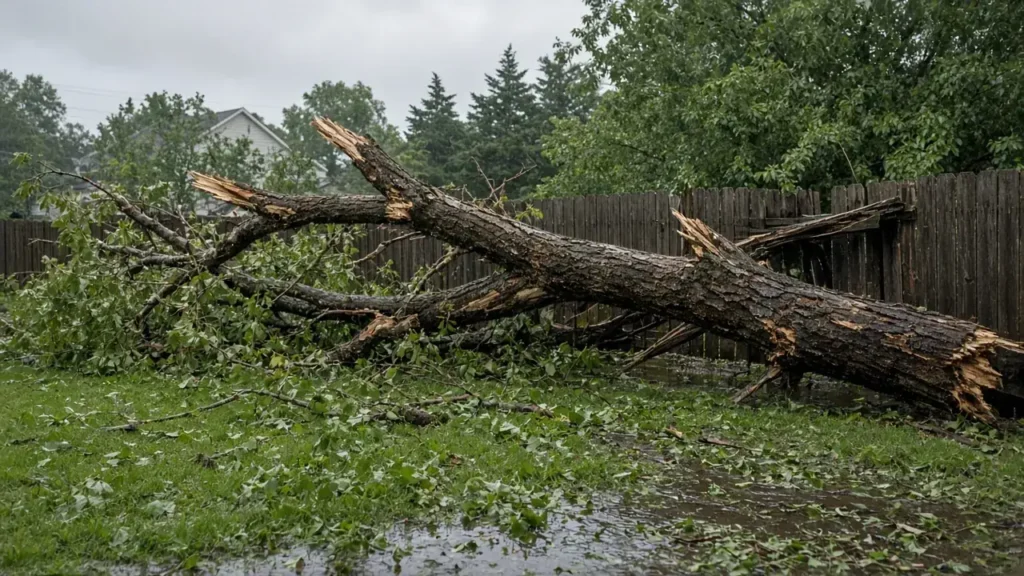
The first useful thing you can do after a storm is slower than you think. The wind has already done the dramatic part. Your job is to not turn a messy yard into an injury, an electrical contact, or a second failure from a branch that is still hung up in the canopy.
This is not an insurance guide and it is not a promise about what any policy will pay. It is a homeowner’s order of operations.
Step 1: Look from a doorway, not from under the tree
Before you walk the whole yard, stand back and ask:
- Are any limbs or whole trees on a power line, a service drop, or a transformer? If yes, stay away, keep others away, and call the utility. Do not touch the tree, the fence it may be leaning on, or a puddle around it. This is the entire answer to “tree leaning on power line.”
- Is a tree or a large limb on the house, and is anyone hurt or trapped? That is 911, then the utility if lines are involved.
- Are there hangers — broken branches still attached or dangling above a walk, a drive, or a play area? Tape off that area. A hanger can finish falling on a calm, sunny afternoon.
If the tree has a new lean toward the house, or the ground looks pushed up on one side of the roots, treat it as unstable. Do not start a DIY cut to “lighten it.” Call a professional crew. See DIY vs hire.
Step 2: Take pictures, then make a short list
Once it is safe to walk, photo the damage — wide shots and close-ups, including the roof, gutters, fences, and vehicles — before you move a lot of wood. If you later talk to an insurer, “before we cleaned up” pictures are easier than a description from memory. That is not a claim strategy; it is just order.
Then list only what is truly urgent: access to the house, a hanger over a path, a branch on the roof that is still moving. The brush pile can wait a day. You do not need to clear the whole lawn before dark with a dull saw.
Step 3: Know what a homeowner can clear
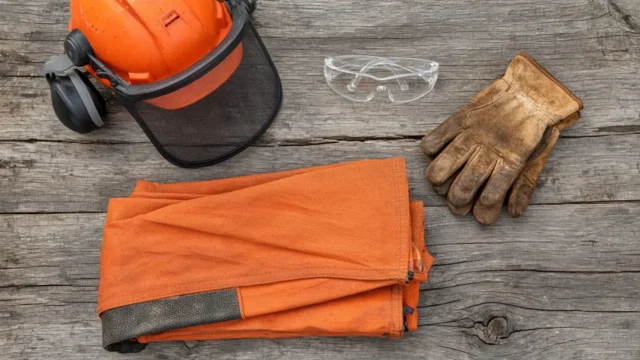
Usually reasonable: small, already-on-the-ground limbs, if you can lift or cut them without a saw above your head and without pulling on wood that is still attached to something you cannot see. Wear gloves and eye protection. Watch for nails, hidden fences, and springy branches under load.
Usually not reasonable: any work on a hanger; any work near lines; a tree on a structure; a split trunk; a root plate that has lifted; a cut that requires a ladder or climbing. After storms, the people who get hurt are often the ones who want the yard to look normal by Sunday.
If you do use a saw on downed wood, you are now in regular chainsaw or pole-saw safety, with extra hazards: wood under tension, dirt in the bark that dulls a chain instantly, and hidden objects. Review pole saw safety if that is the tool, and do not cut a log that is rolled against a fence or under another trunk without thinking about where it will move when the kerf opens.
Hangers, in plain language
A hanging branch is still connected to the tree, or it is pinched in a crotch, and gravity is not finished. You cannot always tell which fiber is holding it. Cutting the “obvious” piece can release a much larger piece, or the butt can kick. Professionals use ropes, another climber, or a lift so they are not standing in the whipping path. A homeowner with a pole saw is often standing exactly where the hanger wants to go.
If you can close the area and wait for a crew, do that. It is the least satisfying advice on this site and the most correct.
After the urgent work
A tree that looked “fine” can still have cracked limbs deeper in the crown. In the days after a storm, walk the yard again (from a safe angle) and look for splits, hanging bark, and new leans. Some damage does not show until the next wind.
Do not do a full cosmetic prune the week after a hurricane or a severe thunderstorm just because the saw is already out. Take hazards, then stop. A planned prune can wait for the right season (when to prune), when you can see what is actually dead versus what is torn.
If a tree lost a lot of its crown or the trunk took a hard hit, use the dead, dying, or dormant checks once the immediate danger is gone, and be willing to spend money on an evaluation for a large tree. A cheap “it will be okay” guess is not a bargain next to a house.
Hiring after a storm
Licensed, insured companies get busy. That is normal. What is not normal is a truck you have never seen, a high-pressure “we can do it right now for cash,” and no proof of insurance. Get the scope in writing. Ask who is in the tree and how they will protect the roof. You can wait a day for a real company if the site is already taped off and lines are safe.
The bottom line
Stay back from lines. Do not walk under hangers. Photograph, then clear only the wood that is already on the ground and not under tension. Everything else is a professional job, even if you own a good pole saw. The saw will still be there when the tree is actually safe to work on.