Last updated: November 21, 2026
In January, a healthy maple and a dead maple can look like the same stick in the lawn. That is why “how to tell if a tree is dead or dormant” shows up in search boxes every winter. You do not want to pay to remove a tree that is about to leaf out, and you also do not want to leave a dead one standing over the driveway until it fails.
You can usually get a honest read with three simple checks: buds or scratch, branch flexibility, and the trunk. None of them require a lab. None of them replace a certified arborist if the tree is large, over a house, or you are seeing mushrooms at the base and a lean toward the roof.
First: decide what “dead” would change
If the tree is a small ornamental you planted last year, these tests tell you whether to wait until June or to replace it. If it is a 60-foot silver maple over the garage, a “maybe dying” result is not a DIY takedown. It is a reason to call someone and, if needed, keep people out from under it. The DIY vs hire guide is the next read when the tree is big.
The scratch (or bud) test
This is the one people remember, and it still works.
On a deciduous tree in winter, look at the twigs on several parts of the canopy — not just one low branch that might have died back while the top is fine, and not just one succulent sprout at the base.
- If the buds are plump and the scales look normal for the species, that is a good sign. “Dry and shriveled on every twig” is a bad one.
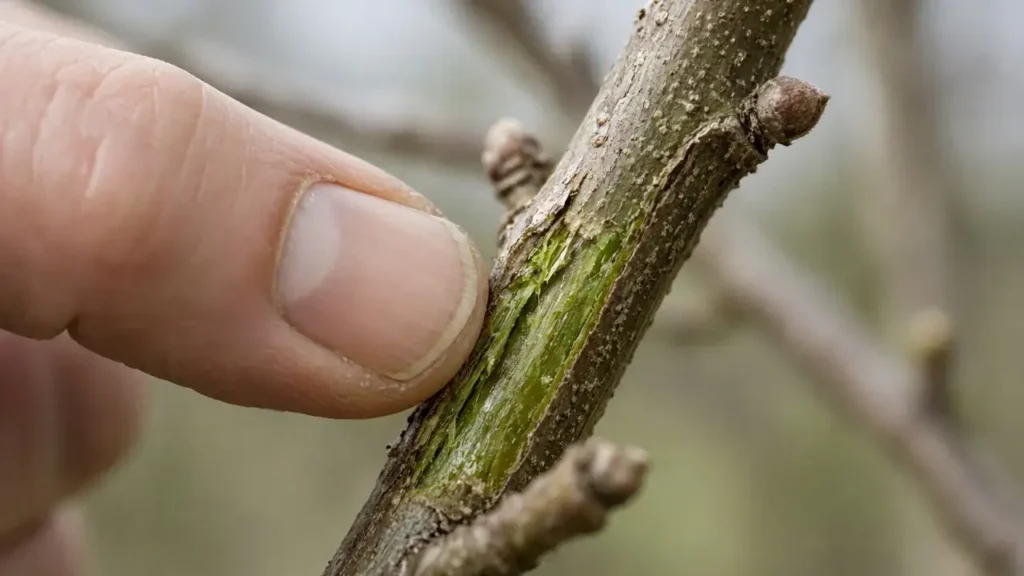
- Scratch a small bit of the outer bark on a pencil-thick twig with a thumbnail or a knife. Green and slightly moist underneath usually means live tissue. Brown, dry, and brittle usually means that twig is dead.
- Do this in more than one place: low, mid, and (if you can see them clearly from the ground) upper branches. A tree can have a dead side and a live side.
Do not carve a big rectangle in the trunk for this. The trunk test is different (below). You are only nicking a twig.
Evergreens do not play the same bare-branch game. A pine or spruce that is merely winter-burned may have brown needles on the windward side and still be alive. Scratch a small twig; look for green under the bark, and look at whether new buds or last season’s candles still have some life. A tree that is brown all the way into the inner foliage, with dry, snap-dead twigs, is in much worse shape than one with outer needles browned after a hard winter. If a large evergreen is fading from the top down, or you see lots of needles dropping out of season and bare interior twigs with no green, treat it as a concern, not as a certain death sentence, and get a second pair of eyes if the tree could hit something.
The snap test (flexibility)
Live small twigs generally bend before they break. Dead ones often snap with a dry crack and a tan, fibrous break. This is not perfect — frozen wood can be brittle, and some species are more brittle than others — so use it with the scratch test, not instead of it.
Walk around after a freeze-thaw, not only at 8 a.m. on the coldest morning of the year, if you can help it. And again: test more than one branch.
The trunk, roots, and base (the “is this tree a hazard?” check)
A tree can have a few dead branches and still be a keeper. That is normal aging, or old storm damage, and it is why we prune deadwood. The worry list is different:
- Fungal conks or mushrooms at the base or on the trunk. Not always a death sentence, but they are a sign of decay that a homeowner should not diagnose from a photo on social media. Get a pro to look if the tree is large.
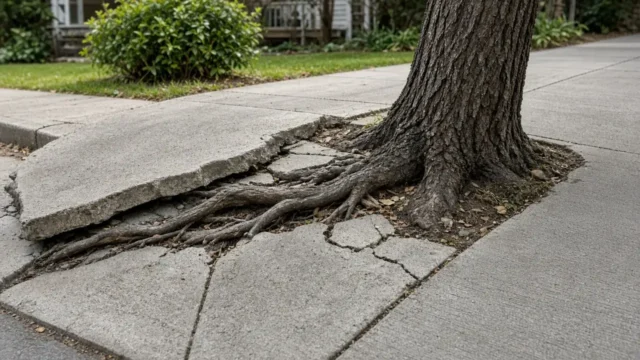
- A new or worsening lean, especially toward a house, a play set, or the street, or a heaving root plate (the ground lifting on one side). After a storm, that is urgent. See after a storm.
- A long vertical crack, a hollow that is more than a curiosity, or a lot of dead wood in the upper crown (“the top is done, the bottom is leafing”).
- Girdling. A tight stake tie, a leftover wire, or a mulch volcano that buried the root flare can kill a tree slowly. Pull mulch back so you can see where the trunk actually meets the roots. The flare should be visible, not buried in six inches of mulch or soil.
- No leaf-out well after every similar tree in the neighborhood has leafed out. This is the spring version of the test. Give it a reasonable window — a red oak can be later than a maple — but if it is mid-June, the oaks down the street are fully out, and your tree is still a bare rack of sticks with brown cambium, you have your answer.
“Dead or dying” is not the same thing
A tree can be in decline for years. You might see smaller leaves, early fall color on one branch, dieback at the tips, or a thinning crown. That is not an automatic “cut it Saturday” moment, especially if the structural wood is still sound. It might be compacted soil, a grading change, a gas or salt issue, drought, or a pest. Some of those are fixable; some are not.
If the tree is small, you can often wait a season, water deeply and infrequently in a drought, fix the mulch, and see whether it comes back. If the tree is large and dropping bigger pieces, or the decline is fast after construction, treat it as a professional evaluation, not a blog diagnosis.
What not to do
- Do not rely on one bare branch in February to condemn the whole tree.
- Do not drill a bunch of holes in the trunk “to see if it’s hollow” as your first move.
- Do not climb it to “check the top” if you are not equipped and trained. Binoculars from the ground are enough for a first look.
- Do not assume a tree that lost its leaves in a summer drought is dead. Scratch test first; wait for the next growing season if the twigs are still green and the tree is not a hazard.
If it is dead
A small dead tree can often be taken down in pieces from the ground, with a plan for where each piece will fall, and with the same safety habits you would use for any saw work. A large dead tree is more dangerous than a large live one — the wood can be unpredictable, and pieces can break off above you. That is a paid job for most homeowners.
If only part of the tree is dead, you may be looking at a prune rather than a removal. When to prune covers the timing; DIY vs hire covers the size and location.
FAQ
The tree has no leaves in winter. Is it dead? Not by itself. That is what deciduous trees do. Use buds, the scratch test, and comparison with the same species nearby.
An evergreen is brown. Is it dead? Not always. Winter burn, salt, and wind can brown the outer needles. Check inner foliage, twig cambium, and whether the browning is on one side or everywhere.
I see green under the bark but no leaves in summer. That can still be a tree in serious trouble, or a tree that leafed out and then got hit by frost, pests, or drought. Watch it, keep people out from under anything loose, and if it is large, have it evaluated.
The bottom line
Scratch more than one twig, look at buds, and be honest about the trunk and the lean. Dormant is normal. Dead is dry and brown in all the places you check, and it still does not always mean you should be the person who takes it down. When the tree is big enough to matter if it falls, pay for a look from someone who will be there if it does.