Last updated: November 21, 2026
The useful question is not “can I cut this?” Almost anyone can start a cut. The useful question is what happens when the branch comes down, and what happens if the cut goes wrong.
If you can stand on the ground, keep the saw away from your head and the power lines, and drop a modest limb into an open part of the yard, you are in homeowner territory. If any part of that sentence made you hesitate, you are in “get a quote” territory. That is not a personality test. It is how people stay out of the ER and off a homeowner’s-insurance claim.
You can reasonably DIY when all of this is true
- The branch is within comfortable reach of a pole saw or loppers from the ground. Your feet stay on the dirt, not on a ladder, not on the roof, not in the tree.
- You can see the whole fall path. Nothing valuable — people, pets, cars, fences, the house, the AC — is in it, or you can control the piece by taking it in sections.
- The wood is not hanging, not split and twisted, and not caught in other branches (those “hangers” and spring-loaded pieces are a different job).
- There is no service drop or power line in the work area, including lines the branch could slide into after it slips.
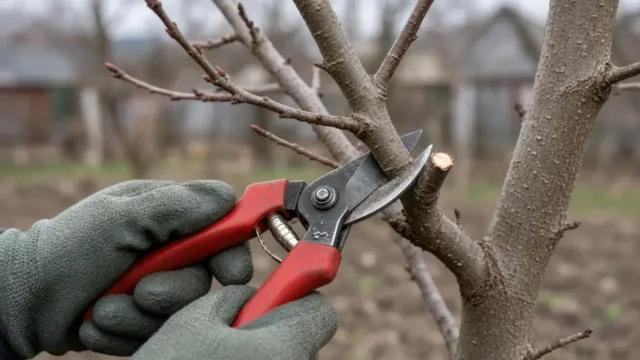
- The cut is one you understand: at the collar, with a three-cut method on heavier wood. See when and how to prune.
- You have eye protection at a minimum, and better gear if a saw is involved.
A cordless pole saw is the right tool for a lot of this. It is not a magic wand. How to use a pole saw safely and the pole saw buying guide are the two pieces to read before you spend the money.
Hire a professional when any of this is true
- Anything near a power line. This is not a “be careful” job. It is a “stop” job. If a limb is already on a line, call the utility. Do not touch it, and do not try to hook it off with a pole.
- The branch or tree can hit the house, garage, or a neighbor’s property if it goes badly. Even a six-inch limb from 25 feet up is a serious object.
- You would need a ladder, spikes, or a rope system to get to the cut. Homeowners get hurt combining ladders and saws. Climbing spikes also damage a tree you intended to keep.
- A hanging or storm-damaged limb is still attached, especially over a walkway or driveway. See after a storm.
- The tree is leaning toward a target, the root plate has heaved, or the trunk is cracked or hollow and you are thinking about removal, not a small prune.
- The job is a full takedown of a tree you cannot convincingly drop into open space. Directional felling is a skill. “It will probably fall that way” is not a plan.
- You do not have a place for the wood and you are hoping it will somehow disappear. A crew’s quote often includes cleanup and disposal. Your Saturday may not.
“When to call an arborist” is also the right search when the question is about tree health — oak wilt concerns, a construction-damaged root zone, a big tree in decline — not just about cutting. A certified arborist (ISA certification is a common credential to look for) is the person for diagnosis and for work on valuable trees. A licensed, insured tree-service crew is the person for removals and large aerial work. Sometimes those are the same company; sometimes they are not. Ask.
“The tree is too tall” is usually not a DIY resize
People search “how to prune a tree that is too tall” hoping there is a homeowner trick. There is not a good one that involves topping. Cutting the top off a mature tree and leaving stubs gives you weak regrowth and a worse tree. A proper reduction is a series of cuts back to sturdy side branches, often at height, often with a climber or a lift. If the tree is simply the wrong size for the spot, a professional can tell you whether a reduction is honest or whether removal and a smaller species is the kinder plan.
Branches hitting the roof are a common, reasonable homeowner project if they are small and you can take them from the ground without standing under them or leaning a ladder against the eaves. If you would have to get on the roof, hire it out. A scratched shingle is cheaper than a fall.
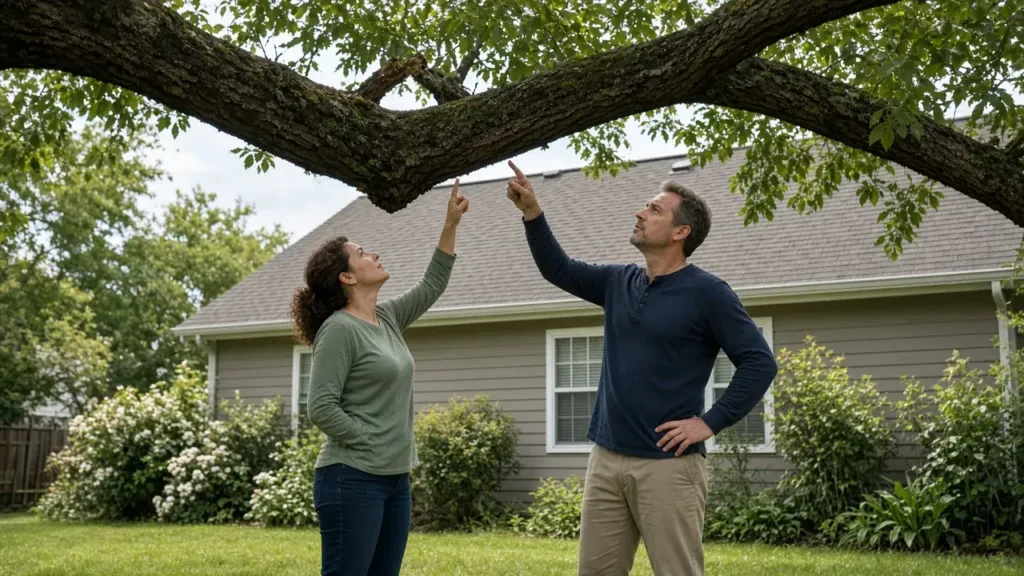
A tree leaning toward the house is not a prune, it is an evaluation. A long-standing slight lean may be the tree’s habit. A new lean, a crack, or soil heaving on one side is urgent, and it is not a pole-saw job.
How to hire without getting a bad surprise
- Ask for proof of liability insurance and, if they have employees, workers’ comp. If someone is hurt on your property and they are uninsured, you can be pulled into that mess.
- Get the scope in writing: what comes down, whether stumps are ground, who hauls brush, and whether the price changes if the wood is “better than expected” or hollow.
- Be wary of a door-knock quote the morning after a storm, especially if they want a large cash deposit and cannot show insurance. Storm work is real; storm scams are also real.
- You do not have to take the cheapest number. You should take a number from a company you would allow to start a chainsaw next to your house.
The lawn under the trees is a different job
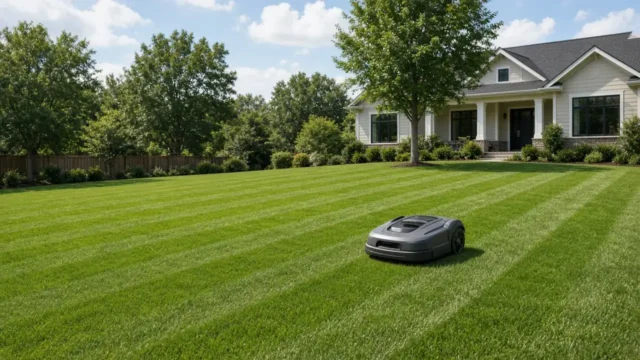
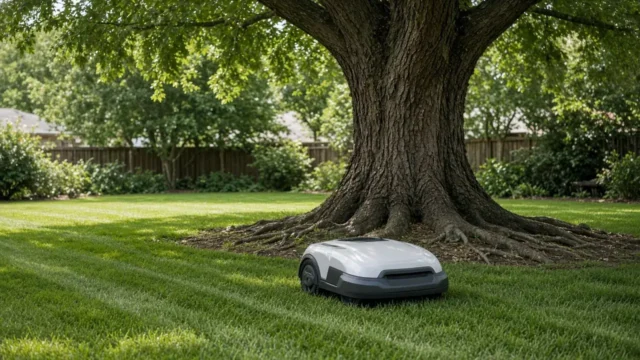
Pruning or removing a tree does not cut the grass. If the reason the yard feels like a second job is weekly mowing around trunks, a slope, or a tree line — not a hanging limb — a wire-free robot mower (or a remote-control mower on a bank a robot should not climb) is the tool, not a pole saw. Start with robot mowers in a yard with trees and, if you are shopping a half-acre of actual grass, the 2026 half-acre robot mower guide.
A simple decision you can use in the yard
Stand where you would stand to make the cut and say, out loud:
“Where will this piece land? What will I do if it hangs up? Is there a line, a roof, or a person in the way? Am I on the ground?”
If any answer is fuzzy, put the saw down. The money you “save” by doing a dangerous cut yourself is not a savings if it goes even a little bit wrong. For the cuts that truly are yours, do them at the right time of year, with the right tool, and with the safety gear on before the chain moves.