Last updated: November 21, 2026
Most backyard trees want a prune in late winter, while they are still dormant — roughly late January through March in much of the northern and midwestern U.S., earlier in the South, later if spring is dragging. That is the short answer. The longer answer is that a blooming ornamental, a pine, and a maple that bleeds sap do not all follow the same calendar, and a limb that is hanging over your roof does not get to wait for the “perfect” month.
If you only remember three things, remember these:
- Take out dead, damaged, or rubbing wood whenever it is a hazard — season is secondary to safety.
- For a routine shape-up on a shade tree, wait until the leaves are off and the tree is dormant, but before it leafs out hard.
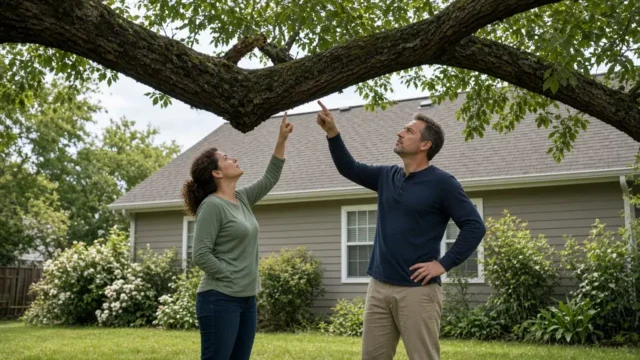
- If you cannot reach the cut from the ground with a pole saw or a pair of loppers, or the branch is over a roof, a driveway, or a power line, this is no longer a calendar question. It is a hire-or-don’t question.
Why late winter is the default
When a deciduous tree is bare, you can actually see the structure. You can tell a crossing branch from a good one. You are not trying to guess through a full canopy. The tree is not pushing a lot of new growth, so a clean cut has time to start drying and closing before insects and some diseases are most active. And you are not carrying a saw through dripping foliage.
“Late winter” is not a date on a gift-shop calendar. In Ohio, where a lot of this advice has been practiced, that window is often February into early March, after the worst deep-freeze nights and before buds swell. In a warm southern year it can start in January. In a long Minnesota winter you may still be waiting in April. Use the tree, not the month: if it is still fully dormant and you can work safely, you are in the window.
A one-page month-by-month version of this lives in our free pruning calendar (coming soon). Use that on the fridge; use this article when you are standing in the yard trying to decide.
When “now” is the right time, even if it is July
Do not wait for February if:
- A branch is broken and hanging (a “hanger”). Those fail without warning.
- A limb is rubbing a roof, a service drop, or a window, or it is clearly dying and over a place people walk.
- Storm damage has left a split crotch or a torn branch. Cut back to a proper union or to clean wood — or stop and call a pro if the tear is large.
Hazard work is year-round. You just work more carefully in leaf-on season because you cannot see as well, and you do not start a “make it look pretty” prune in midsummer heat.
What about fall?
Autosuggest is full of “when to prune trees in fall,” and the honest answer is: fall is usually not the best time for a heavy prune. A tree that you cut hard in autumn can put on a little late growth that does not harden off before a freeze, and some diseases move more easily in cool, wet fall weather. Light cleanup of obviously dead wood is fine. A big structural prune is better saved for late winter, unless you are dealing with a hazard.
If you are cleaning up after a fall storm, that is cleanup, not a styling session. See what to do after a storm.
Species and situations that break the default rule
You do not need a botany degree. You do need to know that a few common yard trees have their own manners.
Spring-blooming ornamentals (lilac, forsythia, some magnolias, many fruit trees grown for flowers): they set next year’s flower buds on old wood. If you prune them hard in late winter, you may cut off the show. The usual homeowner approach is to prune just after they finish blooming. If the tree is also a fruit tree you care about for fruit, follow a fruit-tree guide or a local extension bulletin — that is a slightly different job than “keep the maple off the house.”
Maples, birches, grapes, and some walnuts: they can “bleed” sap if you prune late in the dormant season as sap starts to rise. The sap looks dramatic. It is usually not as dangerous as it looks, but it is messy, and many people prefer to prune those earlier in winter, or accept some dripping. Do not paint the wound to “stop the sap.” Wound paint is almost never helpful on a routine prune.
Oaks, in parts of the country with oak wilt: timing and sanitation matter more than on a generic shade tree. In much of the Midwest, the conservative advice is to avoid pruning oaks in spring and early summer when beetles that can carry oak wilt are more active, and to paint fresh oak wounds only when a local extension or certified arborist says that is the practice in your area. If you have a valuable oak and you are not sure, this is a good moment to ask someone who is certified, not a blog.
Evergreens (pine, spruce, fir): you are not cutting a bare silhouette in February the way you would on a maple. Dead or broken wood can come out when you find it. “Shaping” a pine is easy to mess up; many evergreens do not send new shoots from old bare wood the way a deciduous tree might. If you are tempted to shear a large spruce into a ball, please don’t.
Young trees: a little structural pruning — one leader, taking out a narrow crotch or a branch that is going to rub — pays off more than almost any work you will do on a 40-year tree. Light, early, and with a hand pruner or a small saw beats a pole saw later.
How to prune without killing the tree
“How to prune a tree without killing it” is a real search, and it usually means someone is afraid of taking too much.
- Do not top a tree. Cutting the top off and leaving stubs is how you get weak sprouts, rot, and a tree that is uglier and more dangerous than when you started. If the tree is “too tall,” the answers are a reduction cut to a proper side branch, a different species next time, or a professional — not a flat hat cut.
- Do not take more than about a quarter of the live canopy in a year on a mature tree, and even that is a lot. If the tree is healthy and you are only cleaning deadwood, you are not in that danger zone. If you want to shrink a large tree substantially, that is often a multi-year job, or not a DIY job.
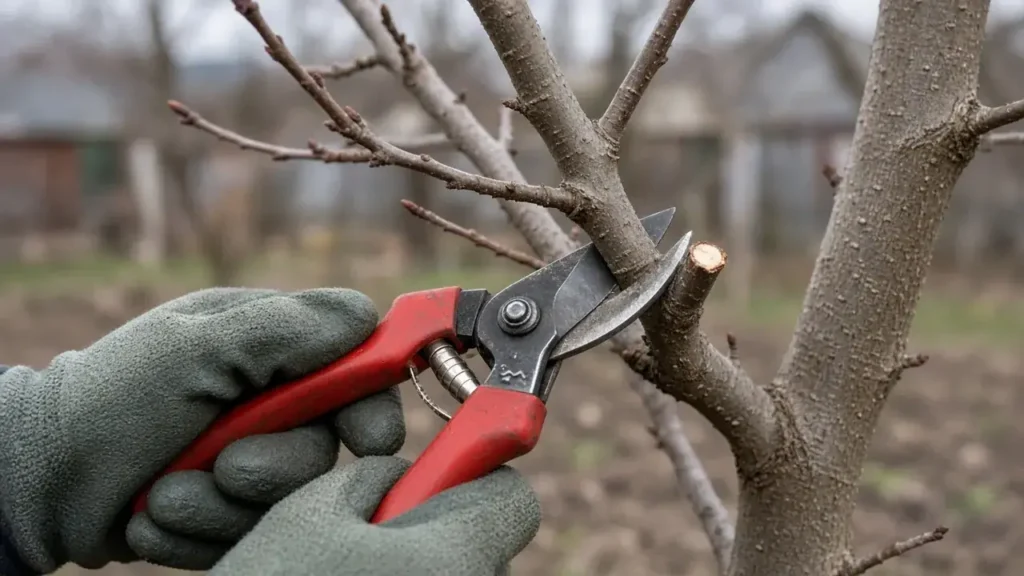
- Cut at the branch collar, not flush against the trunk and not six inches out leaving a peg. The collar is the slightly swollen area where the branch meets the trunk. A flush cut makes a bigger wound. A long stub dies back and invites decay.
- Use the three-cut method on anything heavier than a small hand-pruner cut (roughly two inches and up is a good mental line). First, an undercut a foot or so out from the collar, a third of the way through. Second, a top cut a little farther out, so the branch snaps off without peeling bark down the trunk. Third, a careful final cut just outside the collar. This is the habit that separates a clean job from a torn scar.
- Sharp tools, clean cuts. A dull lopper crushes. A dull pole-saw chain chews and jerks. More on using that saw without hurting yourself is in the pole saw safety guide.
What tool actually matches the cut
- Fingers-thick green wood: bypass pruners (not anvil, if you can help it, on live wood).
- Up to about 1.5–2 inches: loppers, or a pruning saw if the wood is tough or you are tired of twisting.
- Bigger than that, still from the ground: a pole saw or a pruning saw, if you can do it without standing under the fall line and without climbing.
- Over your head, over a structure, or bigger than you are honestly comfortable with: read the DIY vs hire guide before you shop for a bigger saw.
If the job is genuinely a ground-based prune and you need reach, a cordless pole saw is the usual homeowner tool. We keep a current comparison in Best Cordless Pole Saws for Homeowners.
A simple order of work on a Saturday
- Walk the tree from a distance, then walk under it (if it is safe) and look for hangers, cracks, and rubbing branches.
- Mark or at least decide on the cuts before you start the saw. It is easy to keep going because the saw is already out.
- Dead and broken wood first.
- Then branches that rub, grow inward, or aim at the house.
- Then, and only then, a little thinning if the canopy is truly dense. Step back often.
- Rake, check the fall zone one more time, and put the tools away sharp and dry.
FAQ
Can I prune in summer? You can remove hazards. A heavy cosmetic prune is harder on a tree that is already dealing with heat and insects, and you cannot see the structure as well. If you missed winter, do the hazard work and wait.
What if the tree looks dead? Check before you cut the whole thing down. A dormant tree and a dead tree can look similar in January. Use How to Tell if a Tree Is Dead, Dying, or Just Dormant.
Do I need to seal the cuts? For almost all routine backyard pruning, no. Let the tree close the wound. Exceptions are unusual (some oak-wilt regions, some specific grafting or pest situations) and are worth a local expert’s word.
The bottom line
Late winter is your friend for a normal prune. Hazards do not wait. Fall is for cleanup, not a makeover. Leave anything near a power line, over a roof, or beyond a comfortable ground-based cut to someone who does this for a living. If you want the fridge-door version, get the one-page calendar, and if the next step is a tool rather than a phone call, start with the safety article, then the pole-saw guide.