Last updated: November 21, 2026.
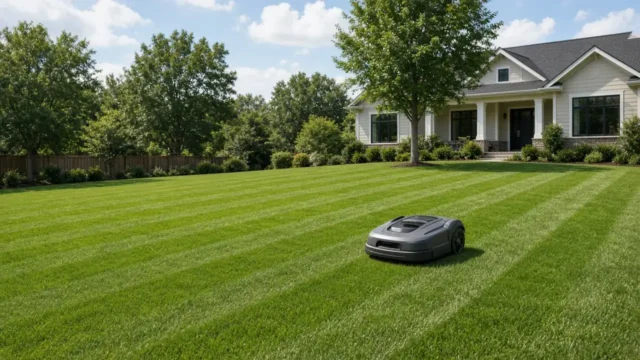
A robot lawn mower can work in a yard with mature trees. The catch is that the lot size on your tax card is the wrong number, and the wrong navigation system will get lost in the shade. Measure the grass, not the property. Prefer a wire-free mower that can still locate itself under canopy (LiDAR or strong vision, not RTK-only in a heavy tree line). Treat a steep bank as a different job — sometimes an all-wheel-drive robot is enough, and sometimes you want a remote-control slope mower instead of an autonomous one. If you came here because a limb is hanging over the lawn, that cut is still a DIY-or-hire decision, not a mower setting.
This sits on Backyard Tree Guide for a simple reason: the same yards that need a winter prune or a pole saw also need the lawn under those trees cut every week. A robot or a remote mower is the “keep the grass honest” half of that job.
Measure the lawn, not the lot
A half-acre lot is 21,780 square feet. After the house, driveway, beds, a play set, and mulch rings around the trees, the actual mowing area is often a quarter-acre with a few awkward strips. Manufacturers rate mowers by maximum mowing area. That number is a ceiling on open, simple turf. If the yard is broken into two zones, wrapped around trees, or full of narrow side yards, shop a rating above the grass you measured — or buy a model that stores more than one map.
Walk the property with a measuring wheel or a simple mapping app and write down:
- Cuttable grass only, in square feet or acres
- The steepest bank you would still want mowed
- Where the tree canopy is thick enough to sit in deep shade at noon
- Paths narrower than about two feet
- Obstacles a blade should never meet: surface roots, low irrigation heads, decorative rock, a dog tie-out
If a “half-acre” mower is rated right at 0.50 acre and your grass is 0.48 acre of messy, tree-broken lawn, you do not have a reserve. That is the situation the half-acre buying guide is written for.
Perimeter wire vs wire-free — and why trees change the answer
Older robot mowers stayed inside a buried perimeter wire. The wire works. It is also a weekend of trenching, a future repair when you plant a new bed or a contractor cuts the loop, and a headache every time you change the lawn shape.
Most 2026 homeowner models sold in the U.S. are some flavor of wire-free:
- RTK / satellite positioning can map a yard quickly in the open. It gets weaker under a dense canopy, next to a tall house wall, or in a side yard that never sees sky. Some kits add a yard-mounted antenna or reference station to help. If your selling point was “no extra hardware,” read the box carefully.
- LiDAR and camera / vision systems build a map from what the mower can see. They tend to be the better fit under trees, which is why they show up so often in “yards with trees” advice. They can still struggle on a messy boundary (mulch that looks like lawn, a raised edge, a vague bed line). Some owners end up driving the first perimeter by hand after auto-mapping fails. That is annoying. It is still less work than burying a wire.
- A hybrid (LiDAR plus network RTK, or vision plus a reference station) is often the practical pick for a tree-heavy half-acre.
“No perimeter wire” is the right search for most tree-filled yards. It is not the same as “zero setup.” You will still set no-go zones around trunks, beds, and anything you do not want the blade to kiss.
Shade, roots, and low limbs
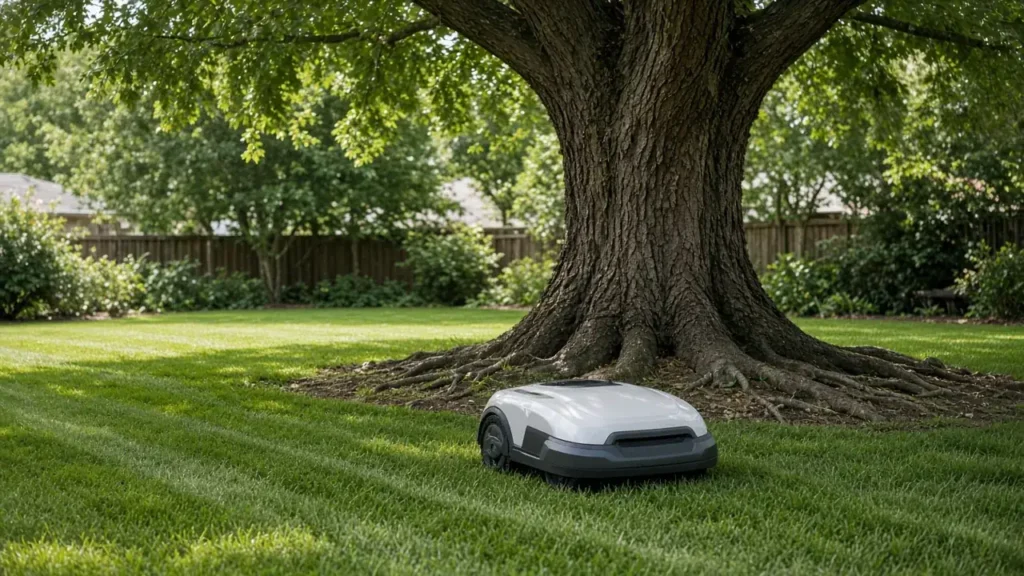
Shade does not usually stop a modern robot from mowing. It can stop a satellite-based mower from knowing where it is. If the back lawn sits under maples or oaks all afternoon, do not buy on an open-yard demo video.
The trees themselves create three lawn problems a robot will not fix:
- Surface roots. A mower deck will scalp them or, worse, catch a root and stall. Raise the cut, keep a mulch ring, or accept that some root flares stay uncut. Do not keep lowering the deck to “clean it up.”
- Low limbs. If you are ducking to walk the lawn, the mower may fit and you will not enjoy walking the same path. That is a pruning job from the ground, with a pole saw used safely, not a mower feature. See when to prune and the cordless pole saw guide.
- Pinecones, sweetgum balls, sticks after a storm. Most robots are lawn mowers, not debris vacuums. After a wind event, walk the yard first. A stick that would only annoy a riding mower can wedge in a robot’s disc.
Leave a clean collar of mulch around trunks. The mower should not be bumping bark every pass. If a robot keeps eating the edge of a bed, the map is wrong, or the bed edge is too soft to be a boundary.
Hills, and when a remote-control mower is the better tool
Manufacturers publish a maximum slope, often as a percent grade. Treat that as a dry-turf, in-the-middle-of-the-lawn figure, not a promise at the wet edge of a creek bank. All-wheel-drive (AWD) models are the ones to shortlist for a real hill. Two-wheel-drive bargains that look fine on a flat lot are the ones that slide, or that simply refuse the bank.
There is a second class of machine people mean when they say remote lawn mower: a walk-behind or stand-on body that you steer with a remote, often built for steep or rough ground a robot is not rated for. These are not “set a schedule and go to work” tools. You are still the operator. You are just not standing on the slope with a conventional walk-behind.
Use a remote-control slope or brush mower when:
- The bank is steeper than the robot’s honest rating, or it stays wet and slick
- The area is too rough, too weedy, or too irregular for a scheduled robot (a ditch, a fence line, a ravine)
- You need to mow a small, nasty patch a few times a year and do not want to spend $2,000+ on a robot that will barely use that zone
Use an autonomous robot when the main lawn is a weekly job and the hill is within the rating. Some households reasonably own both: a wire-free robot for the big, everyday lawn, and a remote mower for the bank the robot should not be asked to climb. That is the “two birds” version of this site — trees and the lawn under them, without pretending one machine does every job.
If you are shopping remote-control slope mowers, start with current in-stock listings and a brand or Amazon link you can actually get parts for. Do not buy a no-name steep-hill unit on a video alone.
Safety, pets, and “set it and forget it”
“Autonomous” is not “unsupervised forever.” You still have a spinning blade in the yard.
- Read the manual’s rules for children, pets, and when the mower is allowed to run. Many households run the schedule while people are at work, not at a Saturday cookout.
- Teach kids that this is a tool, not a toy to ride or block.
- If you have a dog that patrols the fence, watch the first weeks. A confident robot and a territorial dog is a management problem, not a firmware update.
- Lift, carry, and blade-change rules are real. The underside is sharp. Disconnect or power down the way the manual says before you tip it.
- After a storm, you inspect first. Same habit as walking a yard before you start a pole saw.
A robot also will not tell you a tree just dropped a widow-maker on the lawn. That is still on you.
What setup actually feels like
Plan an afternoon, not ten minutes, even on a “tap and go” model. You will place a charging station on reasonably level ground with room to approach, run power, map the boundary, paint no-go zones around trunks and beds, and then watch the first full pass. If auto-mapping keeps leaving the lawn, switch to a manual perimeter drive. That is a common, documented outcome on complicated yards, including a 2026 PCWorld test of a premium AWD LiDAR mower. It does not automatically mean the mower is a lemon. It means the yard is complicated.
If that already sounds like more than you want to own, you may be happier hiring a mowing service, or keeping a walk-behind for a small lawn. A $2,000 robot is a great buy only if you will let it run.
FAQ
Do I still need a perimeter wire if I have a lot of trees?
Usually no, if you buy a 2026 wire-free model whose navigation is not solely dependent on a clear view of the sky. Under a heavy canopy, favor LiDAR or a hybrid system, and be willing to set the first map carefully.
Will a robot scalp around tree roots?
It will if you cut too low or if roots sit above grade. Raise the height and keep mulch rings. A robot is not a way to hide a root problem.
Can I use a robot on a steep bank?
Only within the published slope rating, and with more caution when the grass is wet. For banks beyond that, look at an AWD robot or a remote-control slope mower, or leave that strip to a person with the right walk-behind and good footing.
Is a robot a reason to delay pruning?
No. Low limbs, storm hangers, and branches toward the house are still pruning or removal jobs. The mower just keeps the grass underneath in shape once the air space is safe.
When you are ready to compare models for a half-acre of real grass — especially a tree-broken half-acre — use the 2026 half-acre buying guide.