Last updated: November 21, 2026
A pole saw is just a small chainsaw on a stick. That is the whole appeal, and that is the whole danger. You get reach without a ladder. You also get a moving chain several feet from your hands, a bar that can kick, and a branch that will fall somewhere.
If this is your first time, the goal is not to work fast. The goal is one planned cut at a time, with your feet on the ground and a clear idea of where the wood is going. If the job does not fit that description, it is not a pole-saw job. Read DIY vs hire and put the tool back in the shed.
Are electric pole saws any good?
Yes, for homeowner work. A cordless (battery) pole saw is the right default for most yards: no cord to cut, no gas to mix, less noise, and enough power for typical limbs in the 2–6 inch range, depending on the saw and the wood. Corded saws are lighter on the wallet and never need a charge, but you will spend the whole job managing a cord — and you can cut it. Gas pole saws still make sense if you have a lot of wood, already live in a gas-tool world, and want runtime without swapping packs. They are heavier, louder, and more maintenance.
“Any good” does not mean “good for any branch.” A $90 no-name 6-inch head will disappoint you on a 10-inch oak limb, and no pole saw is a stand-in for a climber or a bucket truck. If you are still shopping, use the cordless pole saw comparison. If you already have one, the rest of this page is how not to get hurt with it.
The rules that are not optional
- Never use a pole saw from a ladder, a roof, a chair, or up in the tree. The whole point of the tool is to stay on the ground. As soon as you add a ladder, you have combined two of the most common ways people get badly hurt.
- Never use it near power lines, including the service drop to the house. If a branch is in or within falling distance of a line, stop. Call the utility or a professional crew. “I’ll just be careful” is not a method.
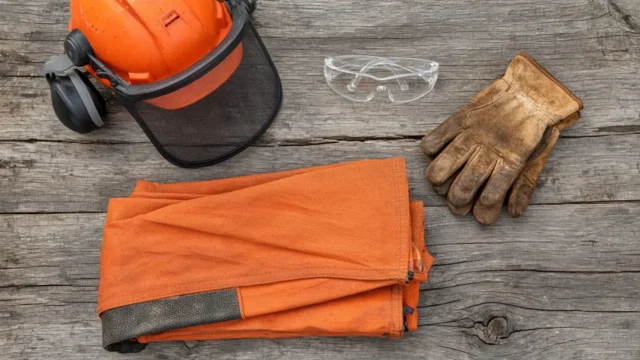
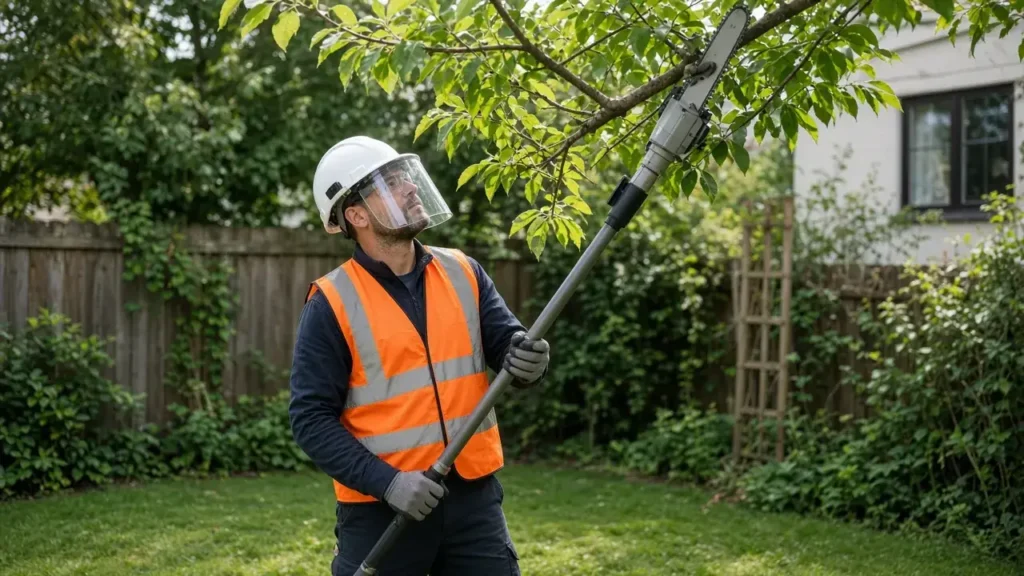
- Never cut directly above your head with the bar over your face, and never stand in the spot you expect the branch to land. Work slightly to the side of the fall line. Hats and helmets exist for the pieces you did not expect; they are not an excuse to stand under the cut. See safety gear.
- Do not use a pole saw on a hanger (a broken branch still attached or hung up in the canopy) unless you truly understand how that piece is held and where it will release. Many hangers are a pro job. After a storm, start with the storm guide.
- Two hands on the saw, boots on, eye protection on, no loose sleeves. Headphones that cancel everything are a bad idea; you want to hear a crack.
Set up the job before you start the chain
Walk the tree. Decide the exact branch and the exact landing zone. Move cars, kids, pets, and anyone who “just wants to watch” out of that zone. A good rule is to treat the radius under the work as closed — not “probably fine.”
Look at how the branch is attached. Is it overextended, already cracked, or heavy on one side? Is it going to swing back toward the trunk or toward the house when the wood separates? If you cannot honestly predict the first four feet of travel, do not make the cut.
Check the saw: chain tension (it should lift slightly but not sag off the bar), bar oil if your model uses it, a charged battery or a sound cord connection, and a clear, dry footing. Read the manual for the chain-brake or lock, the oiling system, and the maximum diameter the manufacturer claims — then stay under that in real wood, especially hardwood.
How to make the cut
For anything more than a small, light piece, use a version of the three-cut method, even at the end of a pole:
- Undercut first, a short way out from the final location, so the bark does not peel a strip down the trunk when the branch drops.
- Top cut a little farther out, until the branch breaks away and falls into the zone you picked.
- Final cut just outside the branch collar, the swollen area where the branch meets the trunk or a larger limb. Do not leave a long stub, and do not cut flush into the collar.
Support the weight of the pole with your body, not just your shoulders. Many saws have a shoulder strap. Use it. Keep the pole as close to vertical or a comfortable angle as the cut allows; a fully extended pole held out like a fishing rod will exhaust you and will wander.
Let the chain do the work. If you are leaning all your weight on the bar and the chain is smoking or stuck, you are either pinched, dull, or into wood that is too big. Stop, think, and maybe take the piece in smaller sections — starting farther out, reducing weight, then making the closer cuts.
When the branch starts to go, you are done pushing. Hold the saw steady, watch the wood, and step only if you planned that step. Then set the saw’s chain on the ground or the lock, and move the piece.
Things that go wrong (and how to avoid them)
The bar pinches. The kerf closes on the chain because the wood was in compression. This is why the undercut and a smaller first piece matter. If it pinches anyway, shut the saw off, support the branch if you can do it safely, and free the bar without yanking like you are starting a lawnmower.
Kickback. The upper quadrant of the bar nose is the classic kickback zone on a chainsaw. On a pole, a kick can be a sudden, ugly lift or twist. Do not bore in with the tip if you can avoid it. Keep the working part of the bar in the cut, and do not cut with the saw above a line where a kick would come at your face.
The branch hangs up. Now you have a new, less stable object in the tree. Do not start yanking it with the pole or climbing after it. Re-evaluate. Many hang-ups are the moment a homeowner should call for help.
You get tired. Fatigue is how form falls apart. Swap a battery, drink water, and stop for the day before you “just do one more.” There is no prize.
After you are done
Clear the wood so no one trips in the dark. Wipe the bar, check tension, top off bar oil, and store the battery according to the manual (not on a wet garage floor, not in a hot truck). Look at the tree’s wounds: they should be clean, at the collar, not ragged. If you tore bark, you rushed the undercut. Remember that for next time.
If you are also deciding when the tree wanted this prune, go back to when to prune. If a job you thought was simple is starting to look like a roof or a line or a hanger, stop mid-project. Walking away is a skill.
FAQ
Can I use a pole saw in the rain? You can get a lot of poor footing and a lot of wet, heavy wood. Electric tools and rain are also a bad pair unless the manufacturer clearly says otherwise. Wait.
How high can I really cut? Marketing “reach” often includes a long-armed person holding the pole up. Your useful, controllable height is less than the number on the box. If you can only just tickle the branch with a fully extended, wobbling pole, it is too high.
Do I need chaps for a pole saw? The chain is usually out in front of you, not against your thigh, but branches drop and people lose their stance. Eye protection is the non-negotiable minimum. A helmet with a face screen is a very good idea when wood is falling. Chaps matter more when you also use a handheld chainsaw; they are not silly if you sometimes bring the bar down low. More in the gear guide.