Last updated: November 21, 2026
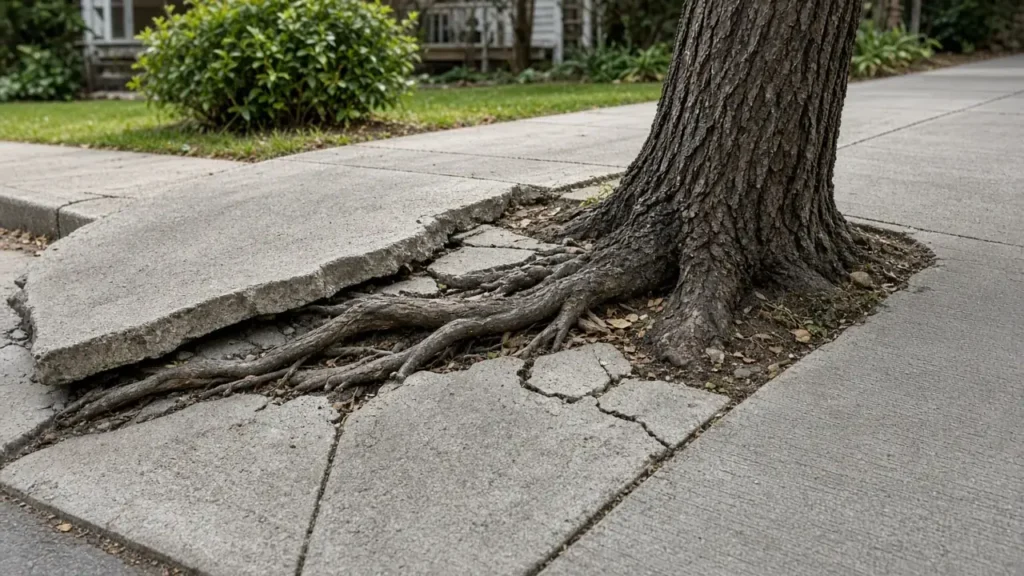
When a sidewalk panel starts to tent, or a driveway slab has a new trip edge, the tree in the parkway is usually the first suspect. Sometimes it is guilty. Sometimes the concrete was thin, the base was poor, and the tree is only doing what roots do: staying shallow where the oxygen and water are.
You can do a lot of damage with a “just cut all the roots” plan. You can also ignore a real trip hazard until someone falls. The middle path is to understand what the roots are doing, fix the hardscape when you need to, and only cut roots with a clear idea of how much of the tree you are willing to risk.
This is general homeowner information, not an engineering or legal opinion about a neighbor’s tree, a city easement, or a blocked sewer. Those situations have local rules and, often, a plumber or an attorney in the mix.
What is actually happening
Tree roots need air as much as they need water. Under a tight lawn or a slab, they often run near the surface. As they thicken, they can lift a sidewalk panel or a floating driveway slab. They can also follow a sewer line that is already leaking, because the leak is a convenient water source. In many older clay or damaged pipes, roots are a symptom of a pipe that was already imperfect, not a tree that “attacked” a perfect system.
A crack in a driveway is not always roots. Freeze-thaw, a poorly compacted base, heavy trucks, and age all do this work. Look for a root flare or a visible root at the same place as the lift, and for a pattern that tracks the tree rather than a random shrinkage crack.
What not to do first
- Do not trench around the trunk and sever every large root on the driveway side “to teach it a lesson.” You can destablize the tree, especially if you cut large roots close to the trunk, and you can send the tree into decline (see dead or dying).
- Do not pour a random herbicide into the soil along the slab and hope. You can injure the tree, other plants, and anything you did not intend to treat.
- Do not assume you can grind a root under a public sidewalk without talking to the city. Many parkway trees and sidewalks are not yours alone.
If the problem is a sidewalk or driveway lift
Short-term safety: mark or grind a trip edge, or put a temporary ramp on a small lip, so no one falls while you decide. Cities sometimes have sidewalk-repair programs; check before you hire.
Concrete grinding can take a small lip down without moving the tree. It is a common municipal and contractor fix when the lift is modest.
Lifting and relaying a panel, or replacing a section of driveway, is the more complete hardscape fix. A thoughtful contractor can add a root barrier, a better base, or a slightly different joint so the next ten years are kinder. A thoughtful arborist can tell you whether a root in the way can be pruned at a distance from the trunk that the tree can tolerate, or whether the tree and the slab cannot share that space.
Removing the tree is the last structural option, not the first, unless the tree is already a poor species in a terrible spot, or it is failing. A stump and a remaining root under the slab can still cause problems for a while, and you lose the shade. If removal is on the table, use the same hiring care as in DIY vs hire.
If the problem is a sewer or a water line
A slow drain, a recurring backup, or a wet stripe in the yard between the house and the street is a plumbing diagnosis first. A camera inspection tells you whether you have roots in a joint, a collapsed section, or a problem inside the house.
From there, the menu is usually some mix of mechanical cleaning, a chemical root treatment inside the pipe (this is a plumber’s product and procedure, not a weekend experiment), a liner, or a replacement. Cutting the tree down does not always fix a pipe that is already broken; other roots, or the same broken joint, can keep the issue alive.
If a city-owned main is involved, call the city before you start digging. If the line is on a neighbor’s run or a shared lateral, stop and sort out who owns it. A shovel is a bad first tool.
Can you keep the tree?
Often, yes — with a hardscape repair, a bit of root pruning done far enough from the trunk, better watering (deep and occasional, so roots have a reason to go down), and a mulch ring that is not a volcano against the bark. Sometimes, no. A large, shallow-rooted species planted in a tiny strip between sidewalk and curb was a conflict from the day it went in. A smaller species, or no tree in that strip, is the long-term peace treaty.
If you are still deciding when and how to prune the top of the tree, that is a separate job with its own timing (when to prune). Topping a tree will not fix a driveway. It will only add a weak canopy to a root conflict.
The bottom line
Treat the trip hazard so no one gets hurt. Find out whether the lift is really a root, and whether the pipe problem is really a tree. Cut roots only with a plan for the tree’s stability, and do not start with removal unless the tree is already the wrong plant in the wrong place or is failing. For anything close to a foundation, a public walk, or a sewer, pay for people who do this every week — a contractor, a plumber, and when the tree is large, an arborist — rather than improvising a trench.